In Hefei, plasma was sustained for 17 minutes and 46 seconds. The result achieved by China’s EAST experimental device in January 2025 is a concrete advance in fusion research. It demonstrates the ability to control plasma for a long period in a demanding operating regime. That experiment did not deliver energy to the electric grid. [1]
The distinction matters. Fusion is surrounded by genuine research results, ambitious schedules and government promises about a future industry. Readers should be able to see where one ends and another begins.
Hefei also represents an offer of cooperation. China is inviting international researchers to use the research infrastructure it is building. For Finland, the question is how to participate in the science while assessing the dependencies created by equipment, expertise and access to knowledge.
What 1 066 seconds demonstrates
On January 20, 2025, EAST sustained steady-state plasma in high-confinement mode for 1,066 seconds. According to the Chinese Academy of Sciences, the device’s previous record in that category was 403 seconds, set in 2023. [1]
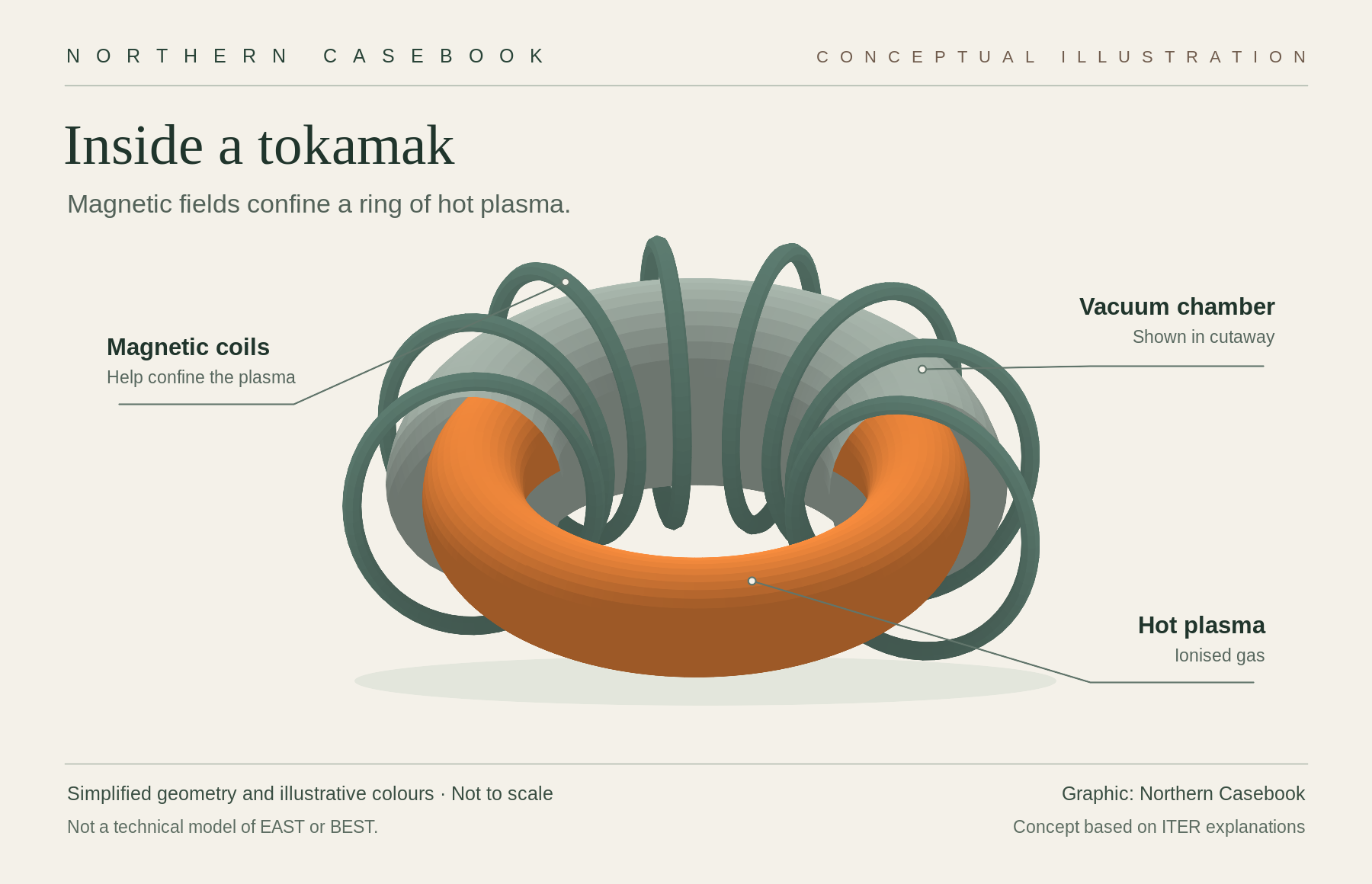
A tokamak uses magnetic fields to confine hot plasma inside a doughnut-shaped vacuum chamber. A long pulse tests the whole system: heating, control, diagnostics and heat removal. Success in one system is insufficient if another limits the experiment. ITER highlights precisely this integration in discussing the EAST and WEST results. [2]
On February 12, 2025, France’s WEST sustained a hydrogen plasma for 1,337 seconds, or 22 minutes and 17 seconds, according to its operator, CEA. [3]
A stopwatch alone cannot establish which experiment is closer to a power plant. The plasma regime, fuel and other experimental conditions matter. EAST’s high-confinement result and WEST’s longer pulse must each be read in their own context. [2, 3]
Hot plasma is one step toward a power plant
Fusion combines light atomic nuclei and releases energy. A practical power plant would have to deliver more usable energy than all its systems consume. It would also have to operate reliably enough, and at costs that make generating electricity worthwhile.
The U.S. National Ignition Facility demonstrated something important but specific in December 2022. Its fusion target released 3.15 megajoules of energy after receiving 2.05 megajoules of laser energy. The comparison concerned laser energy delivered to the target, rather than the entire facility’s electricity consumption. [4]
NIF uses lasers; EAST uses magnetic confinement. Their achievements address different research problems. Neither number can simply be turned into a promise of electricity production.
BEST’s promise remains a target
The BEST experimental device is being built alongside EAST in Hefei. A January 2026 account published by the Chinese Academy of Sciences and attributed to Xinhua describes a goal of demonstrating fusion power gain and fusion electricity generation around 2030. That is a project target, rather than an achieved result. [5]
The term burning plasma also needs care. It describes a plasma in which heating from helium nuclei produced by fusion reactions is the dominant heat source. External heating may still be needed. This differs from a state in which fusion heating alone keeps the plasma hot. [6]
Construction progress must therefore be tracked separately from experimental results. First plasma, deuterium-tritium experiments and a demonstration of electricity generation are distinct milestones. Collapsing them into a single completion date would make the development look simpler than it is.
Even if electricity is eventually produced, questions remain: how much, for how long, with what total energy consumption and how frequently the device needs maintenance?
China is inviting partners and America is still investing
On November 24, 2025, an international fusion research program was launched in Hefei alongside BEST’s research plan. The Chinese Academy of Sciences says representatives of the ITER Organization, the European fusion community and other research institutions took part in the Hefei Fusion Declaration. The program invites overseas researchers to collaborate and use research devices. [7]
The invitation matters. A country can become a research center by providing tools that others need. This raises a practical question for Finland: on what terms does collaboration build domestic expertise, and when does it increase dependence on a partner’s infrastructure?
An unqualified account of American withdrawal does not withstand scrutiny. In September 2025, DOE announced a roughly $134 million fusion research funding package. The announcement’s conditions distinguish selections, negotiations and funding subject to future appropriations; the announced total does not mean all the money has already been paid. [8]
In June 2026, DOE published its finalized Fusion Science and Technology Roadmap. It aims to support pilot plants and commercial fusion power in the mid-2030s. The department explicitly says the roadmap does not commit it to a particular funding level and that implementation depends on future appropriations and partnerships. [9]
China is building international appeal; the United States is developing its own fusion ecosystem. Neither government’s timeline should be treated as a technical guarantee. Competition and cooperation need to be examined together.
Finland’s role also lies inside the machine
Finland is not starting from scratch. VTT coordinates the FinnFusion network and participates in ITER and EUROfusion research. Its stated capabilities include materials, plasma diagnostics, modeling and remote maintenance. [10]
These are areas where fusion’s promise meets practical work. Heat must be removed, materials must endure and components must be maintainable. The value of Finnish participation should be assessed through the problems its researchers and engineers can solve.
Cooperation decisions should therefore ask more than whose flag stands outside a facility. What research data will be available? What can be published? Who holds the rights to use the results? Can work continue if the terms of cooperation change?
These are questions for assessment. An international declaration alone does not answer them, and participation in itself does not demonstrate that every condition benefits Finland.
After the next record
Hefei’s achievement deserves recognition on its own terms. Controlling a long plasma pulse is demanding research. Turning it into a functioning power plant requires further solutions that a stopwatch cannot measure.
When the next major fusion announcement arrives, the essential questions are straightforward: what was measured, what was the output compared with, and what was left outside the calculation?
Finland should watch closely where those answers are being developed. A place in the future energy economy is built through expertise and carefully considered terms of cooperation well before the first commercial fusion power plant is ready.