Spain’s general strike on November 11 brings a household calculation into the streets: what is left after paying for a home, food and energy? Called over housing access and wages, the 24-hour stoppage began at midnight. Its organizers’ expectations do not establish how many people have taken part. Europa Press, 11 November 2026.
Winter adds urgency. Keeping a home warm costs money; losing that home raises the more immediate question of where someone can safely stay. Wars in Ukraine, around Iran and in Sudan are part of this wider cost-of-living emergency. Their effects overlap, but they do not reach Spanish households in the same way.
A woman who never returned home
Maricarmen Abascal, 87, became a symbol of the housing protests after her September 23 eviction in Madrid. She died in hospital on October 7, having remained there since the eviction. That sequence does not, by itself, establish her medical cause of death. Cadena SER, 7 October 2026.
A proposed return came too late. El Español reported that the owner, Urbagestión, had signed the new agreement and delivered the keys to Madrid’s municipal housing company. Abascal died before signing her part. The owner’s account matters: an agreement existed, but it had not restored her home before she died. El Español, 9 October 2026.
Her case leaves a practical question for winter: can assistance secure somewhere suitable to live before a person loses their home? An electricity discount cannot answer that question for someone who has nowhere to use it.
The bills meet in the same household
Spain’s INE statistics office estimated annual consumer-price inflation at 4.9 percent in October, unchanged from September. This was a preliminary estimate. The release showed mixed movements: motor-fuel prices fell more than a year earlier, while gas and liquid heating fuels exerted upward pressure on the annual rate. Not every price is moving together. INE, October 2026 flash CPI, 30 October 2026.
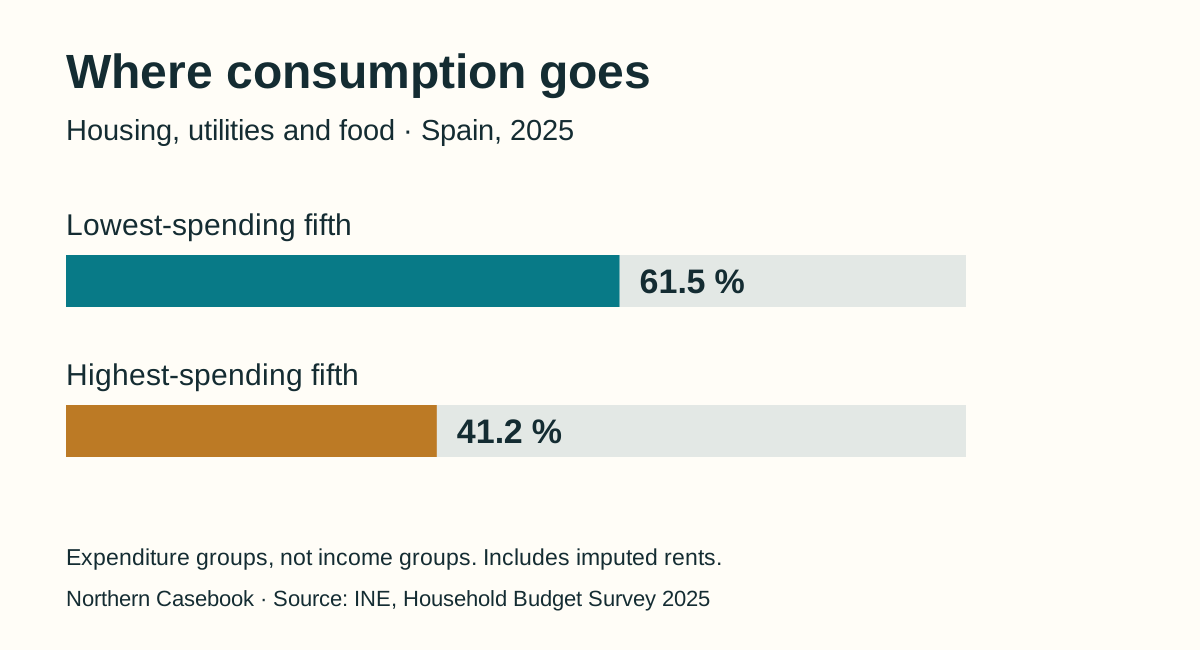
The burden also differs between households. INE’s 2025 budget survey puts housing, utilities and food at 61.5 percent of consumption for the lowest-spending fifth, against 41.2 percent for the highest-spending fifth. INE, Household Budget Survey 2025, 25 June 2026.
Eurostat’s 2025 figures put the share of Spain’s population unable to afford adequate home heating at 15.9 percent, down from 17.5 percent in 2024. That improvement is real. So is the remaining exposure. These are reported affordability difficulties, not a forecast of this winter’s weather or a count of people living outdoors. Eurostat, Key figures on European living conditions 2026, p. 25.
War costs travel through fuel, freight and food
The World Bank’s October outlook links the Middle East conflict to lost oil supply and the Russia–Ukraine war to pressure on energy and food markets. It projects global energy commodity prices to rise 32 percent in 2026 and food commodity prices about 10 percent. Those are forecasts for global commodity markets, not predicted increases in Spanish household bills. World Bank, Commodity Markets Outlook, 28 October 2026.
The Iran-related conflict matters through the Gulf’s energy and shipping routes. Ukraine matters through energy production and the Black Sea grain corridor. WFP describes how disrupted routes increase the cost of moving fuel, fertilizer and food. Higher energy costs can reach farming, processing and transport before reaching the shop. WFP, trade routes and food security, 8 October 2026.
Sudan is both a conflict economy and a country exposed to these external shocks. WFP reports that fighting, displacement and movement restrictions disrupt livelihoods and food access, while Red Sea disruption raises fuel and fertilizer costs. It says sorghum prices are nearly three times their level a year earlier and wheat flour prices have almost doubled. WFP, Sudan emergency, checked 11 November 2026.
Sudan’s war also reaches international ingredient supply chains. Reuters documented disruption and opaque trading in gum arabic, used in food and other consumer products. That establishes a supply-chain connection; it does not establish how much Sudan’s war has added to Spain’s grocery bill. Reuters, 4 March 2025, via Investing.com.
Housing has its own causes — and winter needs an answer
External shocks do not explain away Spain’s housing decisions. Banco de España identifies a weak supply response to growing demand, sharp increases in rents on new contracts, and tourism-related uses reducing residential availability in some areas. War-related costs can squeeze what households have left without being the original cause of their rent problem. Banco de España, Annual Report 2025 digest, pp. 14–15.
IMF research finds that food and energy shocks weigh especially heavily on lower-income households and favors targeted, temporary income support. A lower inflation rate later would mean slower price increases, not an automatic return to the prices families previously paid. IMF, cost-of-living crises, 6 October 2026.
Spain already has protections. The consolidated March crisis-response decree provides exceptional electricity social-tariff discounts for eligible vulnerable consumers through December 31, 2026, and extends water and energy supply safeguards for qualifying consumers to that date. These protections have eligibility conditions; they do not guarantee every household a home. BOE, Royal Decree-law 7/2026, Articles 1–4, consolidated 30 September 2026.
The winter test is concrete: whether help reaches people in time, whether a household can keep its home warm, and whether suitable accommodation is available when a tenancy ends. Building more homes takes time. A person facing the next cold night needs an answer sooner.