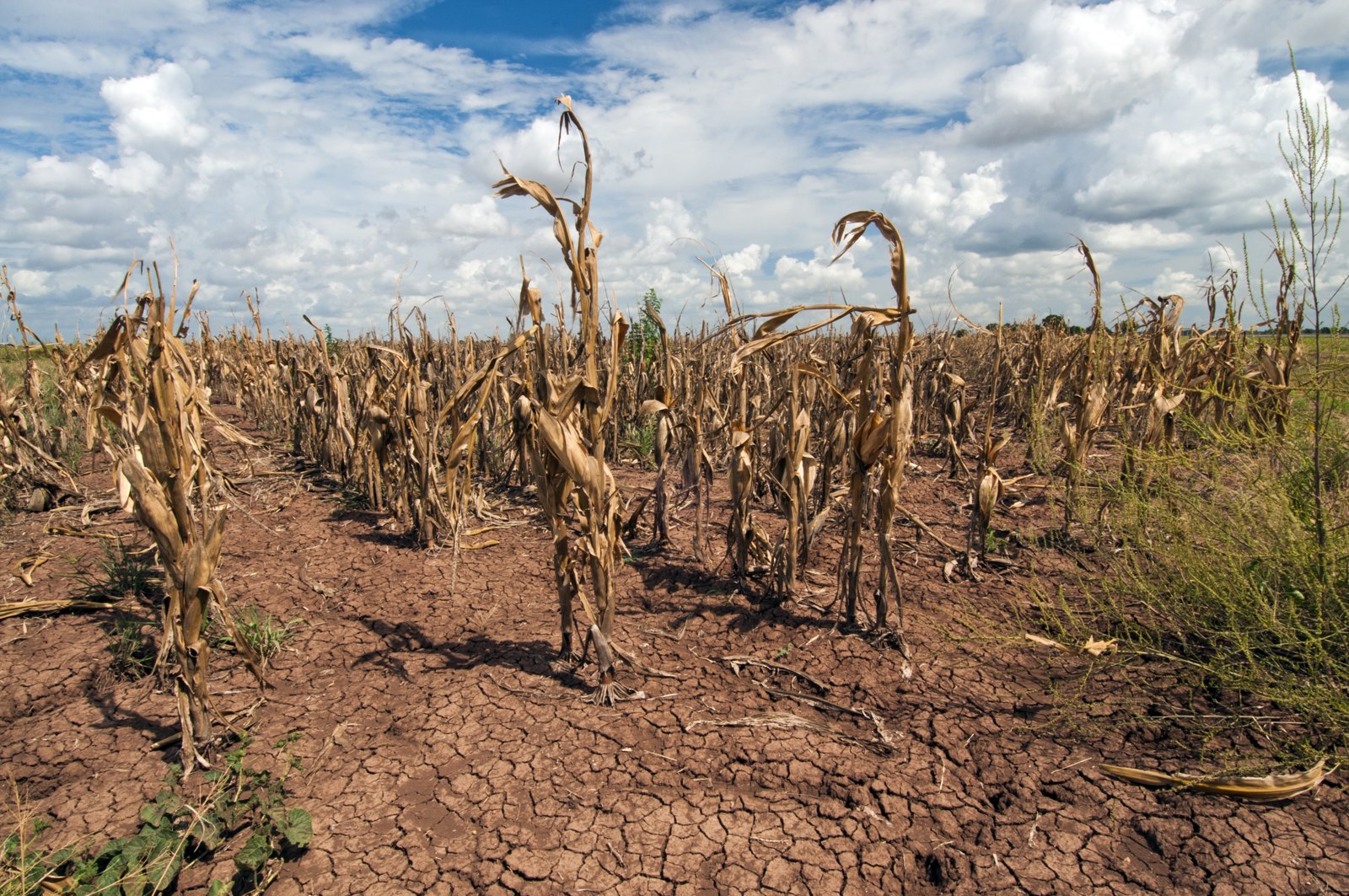

In Cambodia’s Siem Reap province, farmer Sokhoeun Chhut described scorched rice and an exceptionally long drought to the UN Food and Agriculture Organization in October. The crop was already a loss. For a farming household, that can mean food disappearing from the field before the next bill arrives. FAO, Cambodia reporting, October 5, 2026.
El Niño is already underway. Its significance will be measured in harvests, drinking water, working days and the ability to buy a meal. A failed crop can remove a family’s own food and its income together. The weather does not have to worsen everywhere for the consequences to spread.
A dangerous season, with a forecast peak still ahead
Australia’s Bureau of Meteorology reported a strong to very strong El Niño on November 10. Its weekly relative Niño3.4 index was +2.75°C for the week ending November 8, below the event’s weekly peak so far. The October monthly value remained below the historical monthly record. A striking weekly value is not the same as a record for the whole event. Australian Bureau of Meteorology, November 10, 2026.
WMO’s October 21 seasonal outlook forecasts a Niño3.4 sea-surface temperature anomaly averaging about +3.8°C for November 2026–January 2027, with a peak around December. That is a regional ocean forecast, not a 3.8-degree rise in global temperature. It also uses a different measure from the relative index above; comparing the two numbers directly would misrepresent the change. WMO, November–January seasonal outlook, October 21, 2026.
NOAA’s October 8 assessment favors strong to very strong conditions into January–March 2027, with a probability above 83 percent. Its next monthly assessment is due November 12. These dates matter: a forecast of an exceptional event is not proof that its predicted peak has already occurred. NOAA CPC, October 8, 2026.
The same ocean pattern can threaten farms in different ways
Southern Africa’s regional outlook favors below-normal rainfall across much of its central and southern areas during the 2026–27 rainy season. The August forecast includes Zimbabwe, Botswana, Namibia and parts of neighboring countries. It is a seasonal probability, not a declaration that every district will suffer drought. SADC climate outlook, August 27, 2026.
In much of southern Africa, the rains overlap the main growing season. Rain arriving late, or failing during crop development, can affect the harvest and pasture available to animals. FAO also identifies risks to maize and bean seasons in Central America’s Dry Corridor. The agricultural calendar helps determine which weather anomaly becomes a food shock. FAO, El Niño and agriculture, checked November 11, 2026.
The Greater Horn of Africa faces a different outlook. ICPAC’s September guidance favors wetter-than-normal October–December conditions across much of the region. Rain can replenish water and pasture; excessive rain can wash out fields and roads. Local forecasts are needed to distinguish useful rain from danger. ICPAC, October–December outlook, September 10, 2026.
Food production also includes the sea. NOAA describes how El Niño’s warmer waters and altered currents change the distribution and abundance of fish off northern South America. A catch moving away from a fishing community can affect earnings as well as food supply. NOAA, Understanding El Niño & ENSO.
A global grain total can hide a household emergency
FAO’s November 6 forecast still puts world cereal production in 2026 at the second-highest level on record. It projects rice output to fall 2.5 percent, partly because of El Niño-related adverse weather and partly because of poor producer margins. Global rice stocks are expected to remain historically high. A worldwide shortage of every staple is not the present baseline. FAO, Cereal Supply and Demand Brief, November 6, 2026.
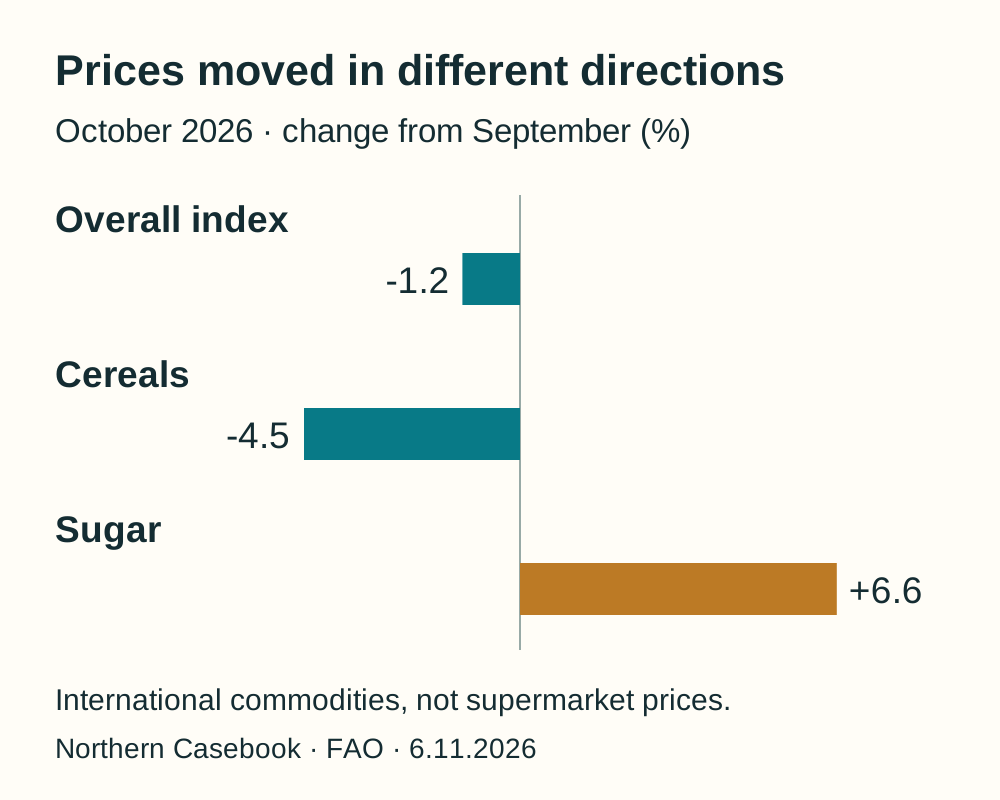
Prices are not moving in one direction either. FAO’s international food-price index fell 1.2 percent in October from September, while remaining 5.9 percent higher than a year earlier. Its cereal index fell; sugar rose. These are international commodity measures, not the prices paid by a particular household. FAO, October food-price release, November 6, 2026.
The World Bank’s October outlook nevertheless warns of overlapping pressures from disrupted energy and grain supplies, fertilizer costs and El Niño. It forecasts global food commodity prices rising about 10 percent in 2026 and another 7 percent in 2027. That outlook is conditional, and it does not isolate an El Niño surcharge for a supermarket basket. World Bank, commodity outlook, October 28, 2026.
For consumers in Northern Europe, the relevant questions are which crops and imports are exposed, how contracts and exchange rates transmit costs, and whether households can absorb them. A Pacific temperature index cannot supply a reliable percentage increase for a Norwegian or Finnish grocery bill.
Losing the harvest can also mean losing the wage
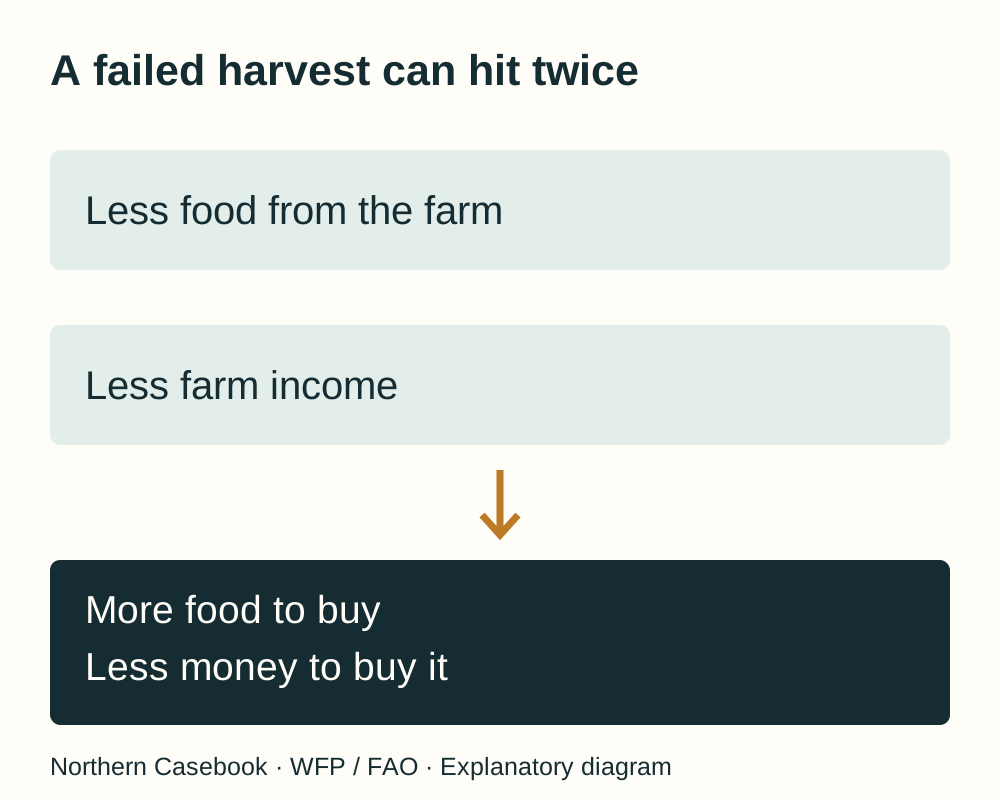
WFP identifies three connected dangers: lost crops and livestock, reduced earning opportunities, and food becoming harder to afford. Agricultural workers can lose paid work even when they own no land. Farmers who must buy replacement food may enter the market with less money at precisely the wrong moment. WFP, El Niño and food security, checked November 11, 2026.
The damage can carry into another season. FAO warns that depleted seed stocks, smaller herds and debt can leave families less able to plant or recover. A weather event can weaken while the household consequences continue. Measuring only this year’s lost harvest misses whether the next harvest remains possible. FAO, El Niño’s hidden losses, July 20, 2026.
When staying home stops being possible
A family may leave when the harvest no longer feeds it, farm work disappears and water becomes harder to obtain. IOM describes these livelihood pressures as pathways linking environmental stress, food insecurity and migration. Movement can be nearby or farther away, temporary or permanent, within a country or across a border. IOM, climate change and migration.
That does not make every departure attributable to El Niño or climate change alone. Conflict, poverty and unequal access to land and assistance also shape the decision. Nor can everyone escape: some families lose the resources needed to move and remain exposed to worsening conditions. IOM, multiple causes and involuntary immobility.
People already displaced may face another move. The Danish Refugee Council’s July 2026 El Niño assessment highlights fragile shelters and risks to food and livelihoods. It maps potential exposure rather than predicting a fixed number of future departures. Protecting people therefore means helping them stay safely where possible, and supporting safe movement when staying becomes untenable. Danish Refugee Council, displacement risk assessment.
Will El Niño get stronger every year?
No. El Niño is the warm phase of ENSO, the El Niño–Southern Oscillation: an irregular ocean–atmosphere cycle, not an annual increase that can be extended as a straight line. A weaker event can follow a stronger one. The more serious long-term question is whether warming changes the distribution of strong events and the damage they cause.
A 2026 study by Julia Cole and colleagues reconstructed eastern Pacific variability using Galápagos corals. It found a large recent increase associated with stronger El Niño events, alongside rising global temperatures. That is evidence of a changing climate risk over longer periods, not a prediction that each future event will exceed the last. Cole and colleagues, Science (2026), abstract via University of Arizona.
A separate 2026 modeling study in Nature Communications projects a stronger influence of ENSO on sea-surface temperatures beyond the equatorial Pacific under greenhouse warming. The authors found this effect even in models with reduced ENSO amplitude, because the surrounding climate becomes more sensitive. Their warming experiments are not forecasts of individual events in 2028 or 2029. Hong and colleagues, Nature Communications, March 19, 2026.
ECMWF also explains why the chosen temperature baseline and use of a relative index matter when comparing events in a warming ocean. Its April discussion addresses forecast limitations and measurement; it is not a current prediction of this winter’s strength. ECMWF, forecast uncertainty and indices, April 10, 2026.
The practical assessment is that stronger extremes and more damaging consequences are risks to prepare for, while a claim of uninterrupted annual intensification goes beyond the evidence. Planning should allow for changing hazards and unequal exposure rather than assume either a steady climb or a harmless return to the old climate.
The useful part of a warning is the time it buys
WFP reports using early cash support, agricultural assistance and warnings before weather shocks deepen. Its September account describes cash assistance for 53,000 people in South Sudan in May and grain-storage support in Guatemala. The agency’s account describes what assistance was delivered; it does not establish the effectiveness of every intervention. WFP, anticipatory-action reporting, September 11, 2026.
FAO’s Cambodia reporting describes field schools using measures such as soil cover, water retention and adjusted cropping calendars. What helps depends on the crop, land, forecast and resources available. Advice is useful only if a farmer can act on it. FAO, Cambodia reporting, October 5, 2026.
The test for the coming months is whether warnings become usable support: water and seed before planting decisions close, income protection before essential assets are sold, and food delivery routes before floods cut access. The predicted ocean peak is one date. The period during which families need help can be much longer.