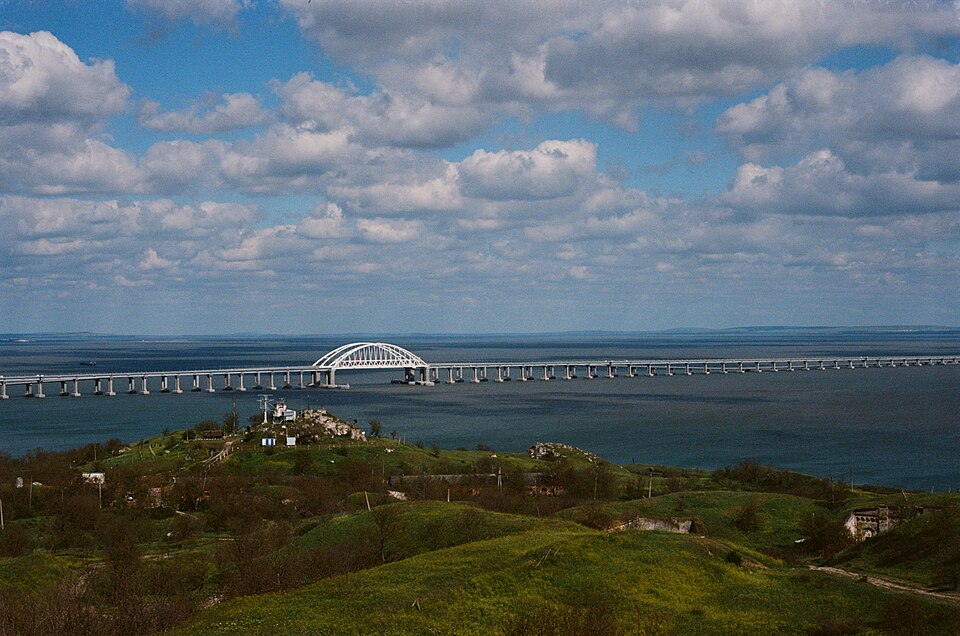
Ukraine has struck the bridge linking Russia to occupied Crimea for a second successive day, damaging a crossing with both military and political importance. President Volodymyr Zelenskyy presented the operation as a response to Russia’s attacks on Ukrainian infrastructure. The strike comes two days before Xi Jinping, Donald Trump and Vladimir Putin are due to meet in China. (Janes, China’s Foreign Ministry)
The immediate question is how much transport capacity has been lost, and for how long. Damage to the road crossing, restrictions on trains and a complete interruption of supplies are different conditions. Reports of one cannot establish all three.
What has stopped, and what still moves?
The Security Service of Ukraine, the SBU, said its forces struck the road section, causing it to fall into the water, according to Janes’ report. Norway’s NTB news agency also reported a partial collapse, while noting that Russian authorities had acknowledged damage. (NTB via ABC Nyheter)
The rail picture changed during Tuesday. Russia’s Transport Ministry said trains were running on one track while restoration work continued on the other, according to St Petersburg Diary’s report. That is an official account of a partial reopening. It does not establish that normal freight capacity has returned.
There is also counter-evidence to an immediate supply-collapse narrative. Sevastopol’s Russian-installed governor, Mikhail Razvozhayev, said food and fuel deliveries to the city were continuing and that the bridge had been used mainly by private cars and scheduled buses. His account, reported by Interfax, is a claim by an occupying authority, rather than an independent assessment of stocks or deliveries across Crimea.
For passengers, the disruption is already practical: getting home, changing connections and finding another route. For assessing the military effect, the missing evidence is different: actual freight movements, available alternative capacity and the duration of repairs. A photograph of a fallen span cannot supply those figures.
In Kyiv, a bridge also carries heat
Russian attacks on Kyiv’s Northern and Southern bridges interrupted traffic and disrupted water and heating services, Ukrainian local officials said, according to Ukrainska Pravda.
The attacks on Kyiv illustrate another kind of dependence. The city’s Obolon district administration said overnight strikes on 17 November damaged heating mains at the Northern and Southern bridges. The municipal heating company was switching affected neighbourhoods to other heat sources and gradually restoring supply. Some consumers would temporarily lose hot water during repairs. (Obolon district administration)
That makes a bridge more than a route across a river. Damage can reach a household through the services connected to it, even when the home itself has not been hit.
The International Energy Agency’s pre-winter assessment identifies both vulnerability and resilience: local power and heat production have helped sustain services, but some delivered equipment remains unconnected and replacement equipment is scarce. Keeping district heating working also limits the extra electricity demand that would come from households turning to electric heaters. (IEA, key findings)
The World Health Organization’s winter assessment links energy disruption to the loss of electricity, heating, water and essential health services. The consequences extend beyond an inconvenient journey: they concern whether basic services remain available through freezing weather. (WHO, September 2026 assessment overview)
A sensitive moment before Shenzhen
China has confirmed that Xi will meet Trump and Putin in Shenzhen on Thursday, 19 November. The announcement gives a date, place and participants; it does not set out a detailed agenda. (Chinese Foreign Ministry)
US officials told reporters that nuclear arms reduction and Iran were planned topics, while Ukraine was not intended for the trilateral discussion. They also played down expectations of a concrete agreement. Those are Washington’s advance descriptions, rather than a guarantee of what the leaders will discuss. (ABC News)
The bridge strike happened two days before the scheduled meeting. Its effect on the discussions is not yet established. The confirmed record includes both Ukraine’s attack on the Crimean crossing and Russia’s attacks on Kyiv’s bridges; timing alone cannot establish a diplomatic consequence.
A separate warning for Europe
The electricity system also carries a safety risk beyond the direct loss of services. On 16 November, European nuclear safety and radiation protection authorities WENRA, HERCA and NORA warned that continued Russian attacks could cause a nationwide grid failure in Ukraine. A prolonged deterioration could threaten nuclear facilities and, in the worst case, lead to a radioactive release affecting areas beyond Ukraine. The warning predates Tuesday’s bridge strike. (Joint statement)
Norway’s nuclear safety authority, DSA, says Ukrainian nuclear plants need external electricity for cooling and other safety functions. It identifies agriculture and food production as particular potential consequences for Norway if an accident in Ukraine produces fallout. That is a conditional assessment, not a report of a release. (DSA)
The common issue is continuity: which services stop, what can replace them and how quickly repairs work. On the Crimean crossing, the unanswered question is remaining transport capacity. In Kyiv, the municipal account already connects damaged bridge infrastructure to interrupted household services. Those are the consequences by which this week’s attacks need to be judged.
Reporting note: Official claims are attributed. Northern Casebook has not independently authenticated the strike videos or measured the bridge’s remaining capacity. Transport and repair information can change rapidly.
Found this useful?
Northern Casebook is free to read. If this story helped, you can support the work with a voluntary contribution. Support does not buy a say in topics, headlines or conclusions.
Support Northern Casebook · Send feedback or a correction · Books by Jaakko Rautio